How Does Laser Tattoo Removal Work on Dark Skin?

Yes, laser tattoo removal can be performed on dark skin, but treatment requires careful laser selection and customized settings. Darker skin contains more melanin, which can absorb some laser energy. Because of this, practitioners need to balance effective tattoo pigment removal with protecting the surrounding skin.

Skin tone, tattoo colour, ink depth, pigment density, tattoo location, and previous treatments can all affect the treatment plan. For people considering laser tattoo removal on dark skin in London, understanding these factors can help you make a more informed decision about treatment.
Is Laser Tattoo Removal Safe for Dark Skin?
Laser tattoo removal can be performed on darker skin when appropriate technology and treatment parameters are selected. However, darker skin requires particular care because of its higher melanin content.
Melanin is the natural pigment responsible for skin colour. When laser energy interacts with the skin, some of that energy may be absorbed by melanin as well as the tattoo pigment.
The goal is therefore to deliver enough energy to target the tattoo while minimizing unnecessary interaction with the surrounding skin.
If treatment settings are not appropriate, potential complications can include:
Hyperpigmentation: the treated skin becomes darker.
Hypopigmentation: the treated skin becomes lighter.
Skin irritation: temporary redness, swelling, or sensitivity may occur.
Scarring: some people, particularly those prone to raised scarring, may have a greater risk following skin injury.
These risks do not mean tattoo removal is unsuitable for dark skin. They highlight why proper assessment, appropriate technology, carefully selected settings, and aftercare are important.
How Does Laser Tattoo Removal Work?
Laser tattoo removal works by directing short pulses of laser energy toward tattoo pigment. The pigment absorbs the energy, causing the ink particles to break into smaller fragments. The body can then gradually clear these fragments over time.
The process is more complicated than simply using a powerful laser.
Different tattoo pigments respond to different wavelengths, while factors such as pulse duration and energy level influence how the laser interacts with the ink and surrounding skin.
For darker skin, the practitioner must also consider how much of the laser energy may interact with melanin.
This means there is no single laser setting that works for every tattoo or every skin type.
Why Does Wavelength Matter for Dark Skin?
A laser wavelength refers to the specific wavelength of light used to target tattoo pigment. Different wavelengths are absorbed by different tattoo colours, making wavelength selection an important part of treatment planning.
The 1064 nm Nd wavelength is commonly discussed for darker skin because it generally has less epidermal melanin absorption than some shorter wavelengths.
However, this does not mean that 1064 nm is automatically the right choice for every tattoo. The tattoo's colour and pigment composition must also be considered.
For example, black, blue, green, and red pigments can respond differently to laser wavelengths. Tattoo age, density, and depth may also influence how the pigment responds.
Key Factors That Affect Laser Tattoo Removal on Dark Skin
Treatment factor | Why it matters |
Skin pigmentation | Influences how laser energy interacts with melanin |
Laser wavelength | Helps determine which tattoo pigment is targeted |
Energy level | Must be appropriate for effective pigment treatment while limiting unnecessary skin effects |
Pulse duration | Affects how laser energy is delivered to the pigment |
Ink colour | Different pigments can require different wavelengths |
Tattoo depth | Deeper pigment may require a different treatment approach |
Ink density | More concentrated pigment may take longer to clear |
Previous treatment | Earlier reactions can influence future treatment settings |
What Laser Is Used for Tattoo Removal on Dark Skin?
There is no universal laser that is best for every person or tattoo. The appropriate technology depends on the individual's skin type, tattoo pigment, treatment history, and other factors.
The 1064 nm Nd wavelength is one option commonly considered when treating darker skin because of its lower interaction with epidermal melanin compared with some shorter wavelengths.
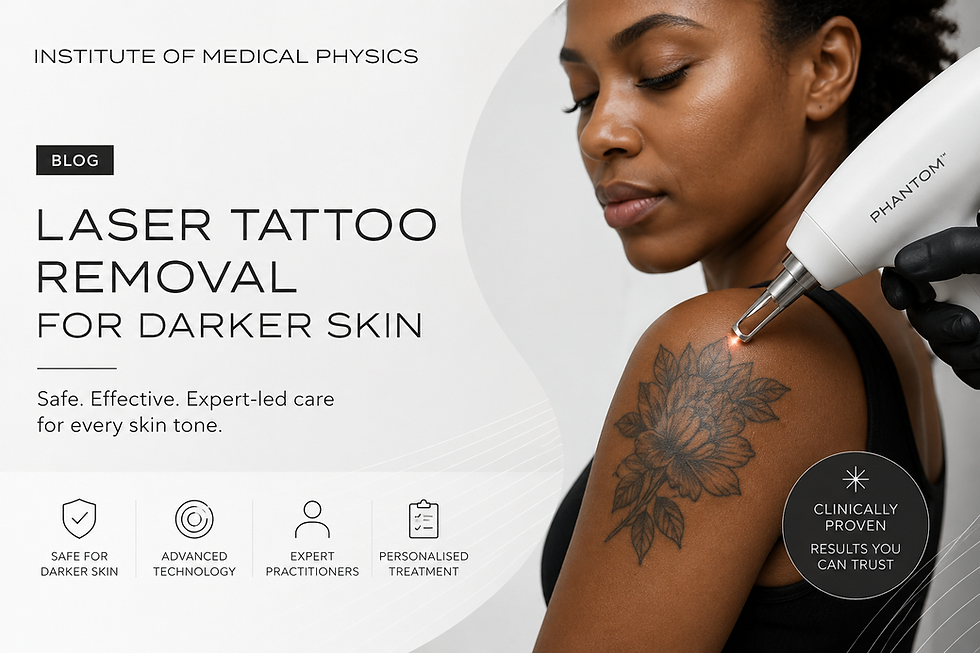
Some tattoo removal systems use different approaches. The Institute of Medical Physics describes the Phantom™ system as using acoustic shockwaves to disrupt tattoo ink particles rather than relying solely on heat.
The suitability of any system should be assessed on an individual basis. The important consideration is not simply choosing the strongest laser but selecting an appropriate treatment approach for the person's skin and tattoo.
How Are Laser Settings Adjusted for Dark Skin?
A stronger laser does not automatically mean faster tattoo removal. Using excessive energy can increase the risk of unwanted skin reactions.
Treatment parameters may be adjusted according to:
Fitzpatrick skin type and individual pigmentation
Tattoo colour
Ink composition
Ink density
Tattoo depth
Tattoo location
Previous tattoo removal treatments
The skin's response to previous sessions
The amount of time between treatments
Is Patch Testing Important for Dark Skin?
A practitioner may perform a small patch or spot test before treating the full tattoo.
This allows them to observe how the skin responds to the selected treatment settings. The results can help determine whether adjustments are needed before proceeding with a larger treatment area.
The objective is to find an appropriate balance between breaking down the tattoo pigment and minimizing unnecessary effects on the surrounding skin.
What Makes Some Tattoos Harder to Remove?
The number of sessions and overall treatment response can vary significantly from one tattoo to another.
Tattoo Colour
Black ink often responds well to laser treatment, while certain other colours may require different wavelengths or treatment strategies.
Tattoo Depth
Ink placed deeper in the skin can take longer to clear and may require additional treatment sessions.
Ink Density
Dense professional tattoos can contain more pigment than lighter amateur or cosmetic tattoos, potentially affecting the treatment process.
Tattoo Age
Older tattoos may respond differently from newer tattoos, although age alone does not determine how easily a tattoo will be removed.
Previous Treatments
Previous laser sessions or other removal methods can affect the skin's condition and should be considered when planning further treatment.
For these reasons, it is difficult to accurately predict the number of sessions based only on tattoo size.
How Many Laser Tattoo Removal Sessions Are Needed?
There is no fixed number of sessions required to remove a tattoo from dark skin.
The total treatment course can depend on:
Tattoo colour
Ink density
Ink depth
Tattoo size
Tattoo location
Skin type
Individual skin response
Previous treatment
Time between sessions
Laser tattoo removal is generally performed over multiple sessions rather than one appointment. The time between treatments allows the skin to recover and gives the body an opportunity to gradually clear fragmented pigment.
A personalized assessment is therefore more reliable than a standard session estimate.
What Happens After Laser Tattoo Removal?
Temporary redness, swelling, sensitivity, or other short-term skin reactions can occur after laser tattoo removal.
Aftercare is particularly important for darker skin because post-inflammatory pigmentation changes may occur.
Your practitioner may provide instructions about:
Keeping the treated area clean
Protecting it from unnecessary sun exposure
Caring for the skin while it heals
Using suitable sun protection
Monitoring the area for unusual reactions
You should also tell your practitioner about previous scarring, pigmentation changes, skin sensitivity, or reactions to earlier tattoo removal treatments.
How Can You Reduce the Risk of Pigmentation Changes?
There is no way to guarantee that pigmentation changes will not occur, but careful treatment planning can help manage the risk.
Important considerations include:
Choose an appropriate laser wavelength.
Use treatment settings suited to your skin type.
Consider patch testing before full treatment.
Allow adequate time between sessions.
Follow your practitioner's aftercare instructions.
Protect the treated area from unnecessary sun exposure.
Tell your practitioner about previous skin reactions or treatments.
Final Thoughts: Laser Tattoo Removal on Dark Skin
Laser tattoo removal on dark skin is not simply about using the most powerful laser. Effective treatment depends on finding the right balance between targeting tattoo pigment and protecting the surrounding skin.
Melanin, tattoo colour, ink depth, density, wavelength, energy level, pulse duration, and previous treatment history can all influence the treatment approach.
The 1064 nm Nd wavelength is commonly considered for darker skin because it generally has less epidermal melanin absorption than some shorter wavelengths, but the appropriate treatment depends on the individual tattoo and skin characteristics.
If you are considering laser tattoo removal for dark skin in London, a professional consultation can help determine which technology, wavelength, and treatment parameters may be appropriate for your tattoo and skin type.
Frequently Asked Questions About Laser Tattoo Removal on Dark Skin
Is laser tattoo removal safe for dark skin?
Yes, laser tattoo removal can be performed on dark skin when appropriate technology and treatment parameters are used. Skin type, tattoo characteristics, previous treatments, and individual skin response should all be considered before treatment.
What is the best laser for dark skin tattoo removal?
There is no single laser that is best for every tattoo or skin type. The 1064 nm Nd wavelength is commonly considered for darker skin because it generally has less epidermal melanin absorption than some shorter wavelengths. The appropriate choice still depends on the tattoo pigment and individual skin characteristics.
Does laser tattoo removal cause hyperpigmentation?
Hyperpigmentation is a potential risk of laser tattoo removal. Hypopigmentation can also occur. Appropriate treatment settings, suitable intervals between sessions, and proper aftercare may help reduce the risk of unwanted pigmentation changes.
Can black tattoos be removed from dark skin?
Black tattoos can be treated on dark skin, but treatment settings must be selected carefully. Black ink often responds well to laser treatment, while the overall response can also depend on ink depth, density, tattoo location, and the individual's skin response.
Is 1064 nm Nd safe for dark skin?
The 1064 nm Nd wavelength is commonly considered for darker skin because it generally has less epidermal melanin absorption than some shorter wavelengths. However, the appropriate settings and treatment approach should be determined based on the individual's skin and tattoo.
How many sessions are needed for tattoo removal on dark skin?
There is no standard number of sessions. Tattoo colour, size, depth, density, location, skin response, and previous treatments can all influence how many sessions may be required.
Is patch testing necessary before tattoo removal?
A practitioner may recommend a patch or spot test before treating the full tattoo. This can help assess how the skin responds to the selected treatment settings and whether adjustments are needed.
What should I do after laser tattoo removal?
Follow your practitioner's aftercare instructions carefully. These may include keeping the area clean, protecting it from unnecessary sun exposure, using suitable sun protection, and monitoring the treated skin while it heals.
Is Phantom™ different from conventional tattoo removal?
The Institute of Medical Physics describes Phantom™ as using acoustic shockwaves to disrupt tattoo pigment while limiting direct interaction with surrounding skin. The suitability of the system depends on the individual's tattoo and skin characteristics.


Comments