Laser Tattoo Removal for Coloured Ink Which Colours Fade Fastest

Some tattoo inks are naturally resistant to lasers. Black ink is the easiest to remove because it absorbs the most laser light. Other colors, especially those that are very faded or have been bleached may be more difficult or even impossible to remove.

Pigment type depth at which it is placed, the age of the tattoo, skin tone, and the laser system used will influence the overall result.
If you are thinking of Laser Tattoo Removal in London, having knowledge of the way different colors respond to therapy will make the treatment plan much clearer. There is no one universal color order that is valid for all tattoos or persons, but certain common color behaviors have been well documented.
Which Tattoo Ink Colours Fade Fastest?
Laser tattoo removal works by delivering short pulses of energy that break tattoo pigment into smaller particles. The body's immune system then gradually clears those particles. Because different pigments absorb different wavelengths of light, the laser used may need to change depending on the color being treated.
Ink color | General response to laser treatment | What to know |
Black | Usually one of the more responsive colors | Absorbs laser energy efficiently and is commonly easier to target |
Red | Often responds well with an appropriate wavelength | Treatment parameters need to be selected for the specific pigment |
Blue | Can respond well, but varies by pigment | Dark blue may behave differently from lighter shades |
Green | Can be more challenging | The right wavelength and laser system are important |
Yellow | Often difficult | Light pigments can be harder for lasers to target |
Orange | Variable | Some orange pigments respond, while others may require more treatment |
Purple | Variable | Results depend on the pigments used to create the shade |
White | Often among the more difficult colors | White pigment can respond differently to laser energy and may require careful assessment |
This table describes general tendencies, not a guarantee of how a particular tattoo will respond. Modern laser systems can address a wider range of pigments than older technologies, but some colors may still require more time and carefully selected treatment settings.
Why Do Some Colours Fade Faster Than Others?
Ink Depth
You inject tattoo ink into the deeper layers of the skin. When pigment is very deep or heavily packed in the skin, the laser has to go through more layers before reaching the pigment which may cause several sessions of treating that area.
Affected area also requires some time during and after every session to naturally eliminate fragmented pigment. Therefore removing a tattoo entirely is usually impossible to do in one treatment.
Skin Tone
One of the main reasons why the skin tone itself is so important is that the laser has to be able to identify the pigment of the tattoo from the normal skin color. As a precaution, the treatment settings ought to be chosen very carefully to avoid any unexpected alterations of the color or pigmentation.
It must be said though that people with darker skin are still not only allowed but advised to go for lasers tattoo removal, the treatment in that case has to be a bit more conservative.
The skin assessment as well as spot testing can provide an idea about how the skin reacts before going ahead on more areas.
Age of a Tattoo
Many older tattoos are lighter than younger ones and thus, it may be easier to remove the remaining color. However, age is not the only factor that influences the result.
A 15-year-old tattoo having dense, deep pigment could still be challenging to get rid of compared to a newer tattoo with a small amount of shallow ink. Color, location, ink density, as well as how a person's skin reacts these are all important factors too.
Laser Technology
Laser technology has been progressing significantly and now, one can choose from several laser settings, depending on the tattoo's pigment colors, etc. That is why a laser system that offers various wavelengths can be the right choice when one's tattoo is painted in different colors.
Cleveland Clinic for instance points out that different wavelengths such as 532, 670, and 1064 nanometers might be used in tattoo lasers to destroy different pigment properties.
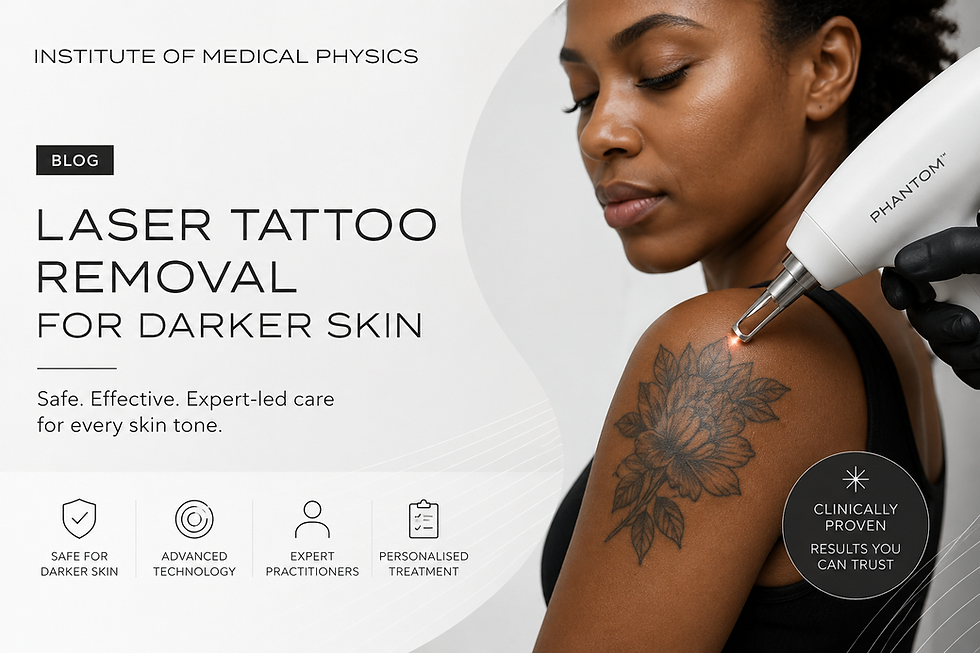
Phantom™ system that Institute of Medical Physics talks about, as they describe the method of an acoustic shockwave, is designed and created with the help of various ways to treat the tattoo inks as well as the different kinds of skin types. It also states, on its treatment page, that on average, it takes 15-30 minutes per treatment session in case of a single tattoo, depending on the size and complexity of such a tattoo.
What Should You Expect From Coloured Tattoo Removal?
Coloured tattoo removal typically does not happen suddenly but rather the result of a slow process. The practitioner will initially take into account the tattoo's colors, size, depth, location, age, and your own skin features. If you have had previous tattoo removal treatments, these could also contribute to the practitioner's assessment.
Usually more than one treatment is necessary because the body has to clear the fragments of the ink left by a removal therapy between the treatment itself. According to the American Academy of Dermatology, tattoos are applied in layers and the skin has to restore itself between sessions.
Temporary changes like increased redness, swelling, etc., which are all typical skin reactions to a certain laser wavelength being fired at the site, may occur. More serious side effects like scarring or pigment alterations are conceivable too, especially if the treatment is carried out without proper medical evaluation or method.
Thus, the main aim shouldn't be simply to get laser treatment for every color. The better approach is, in fact, to verify if the way the treatment will be delivered can really deal with your particular ink and skin condition.
Black ink is probably the least difficult color to treat as tattoo color while it can be quite difficult to treat yellow and white ink. As for the colors of red, blue, green, orange, and purple, they are a bit tricky in nature with the tattoo's response highly dependent on pigment type as well as laser wavelength.
It is quite better to assess the tattoo properly than to consider the tattoo's response to laser treatment solely on color aspect. The combination of factors type of ink used, depth, age of the tattoo, skin color, and treatment technology will result in a prediction of how the tattoos could have reacted. Book a consultation today!
Frequently Asked Questions
Is black tattoo ink the easiest to remove?
Usually, black is among the most easily removable tattoo colors because it effectively absorbs the laser light. Of course, the depth, density, age, and composition of the ink will also impact the quickness of the fading.
Are tattoo colors the problem when trying to remove a tattoo?
There are many colored tattoos which are harder to remove, although it is a mistake to categorically assume that "colored" is "hard". Some reds and blues may work very well; the light shades, such as yellow and white, may have greater resistance. The precise pigment and wavelength lasers that are available will influence the result.
Is it possible to remove yellow and white ink tattoos?
These two colors are among the ones that are most challenging for laser treatment since lighter pigments react differently from darker ones when subjected to laser energy. Some may fade quite a lot, but complete removal cannot be guaranteed. Beforehand, it is best to get a skin consultation to determine how the targeted skin area is expected to respond.
Does darker skin make coloured ink tattoo removal impossible?
Darker-skinned individuals can successfully remove a coloured ink tattoo using a laser. The reason for that being the laser should be chosen depending on both the surrounding skin pigment and the actual ink in the tattoo. With the right diagnosis, laser selection can be done safely so that the probability of unwanted pigmentation changes is low.
How many sessions are needed for coloured ink tattoo removal?
No general figure can be given for this. One reason for this is the variation in the color and size of the tattoo to be removed and, of course, skin type. The number of removal sessions needed also depends on how the skin regenerates itself. The fragments of pigment which the laser has generated have to be transported out of the body.
Therefore, different tattoos have varying results. Whereas some show a great reduction after only a few treatments, others may still have the ink in their skin even after having passed many sessions.

Comments