How Does Phantom Laser Tattoo Removal Work?

Modern technology now offers ways of removing undesired tattoos by using lasers to attack the pigments below the skin surface and letting the body eliminate the broken down ink.
The Phantom laser treatment for tattoos involves a method that is distinct from that of ordinary laser treatment machines. Unlike other laser treatments, which mainly utilize heat in order to impact the tattoo ink, the Phantom™ machine uses acoustic shocks to break down the pigments.
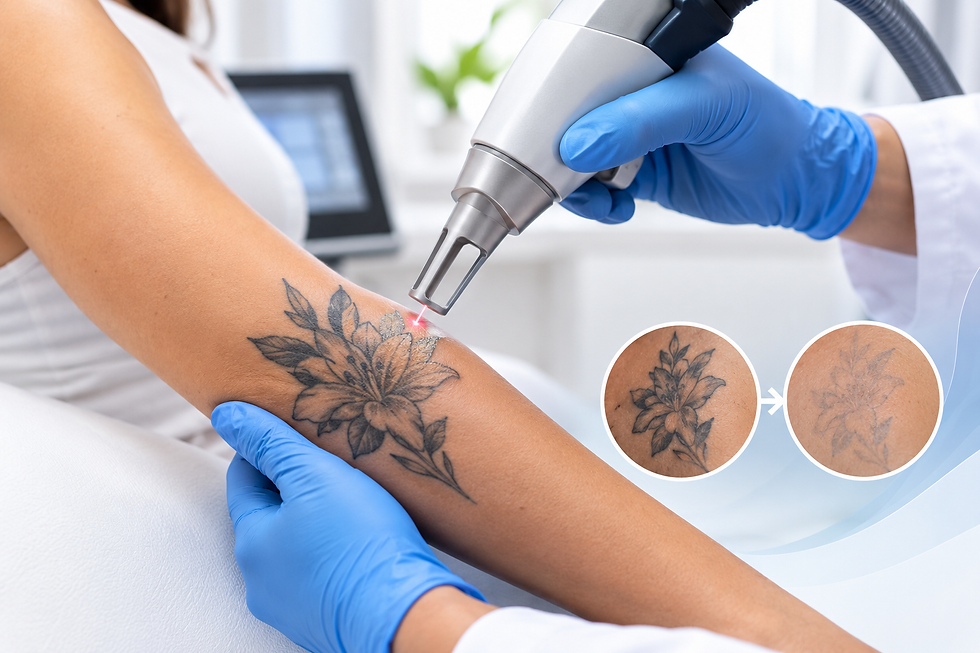
Understanding the process of treatment below your skin can help in comprehending the procedure better.
What Happens When a Tattoo Is Created?
The tattoo ink is injected deep into the dermis of the skin. The pigment molecules are too big for the body to absorb, so the body cannot dispose of them. Thus, they continue being on the skin and forming the tattoo.
It is true that the body treats the ink like foreign material. There are interactions between the immune cells and the pigment, but some molecules of the pigment are too big to be disposed of immediately.
That is why laser tattoo removal is based on breaking down these pigment molecules. If the molecules become smaller, the body will be able to absorb them.
Understanding the Laser Tattoo Removal Process
The laser tattoo removal process usually involves several stages rather than one treatment.
1. Assessment and patch testing
The consultation helps in assessing the tattoo in terms of its size, colour, position, and how it will respond to treatment. The skin characteristics are also crucial in determining how treatment will be done.
Patch testing can be required before treatment. As indicated by the Institute of Medical Physics, patch testing can aid in determining how the skin reacts to the laser.
2. Laser treatment
Controlled beams are directed towards the tattoo during the session. The technology and settings to be used are dependent on the tattoo as well as the individual being treated.
The aim is to fragment the pigment without causing excessive damage to the surrounding skin.
3. Natural pigment clearance
The process of removing the ink from the tattoo continues even after the session. After fragmentation, the body will eventually remove the smaller fragments of the pigment.
This is why the fading of tattoos is gradual and not instantaneous. It is noted by the NHS that the fragmented pigment is slowly cleared by the immune system of the body weeks after the treatment.
4. Recovery and reassessment
Skin requires time for recovery in between procedures. The temporary side effects like redness, swelling, and changes in skin pigmentation may appear after laser treatment. According to NHS advice, changes in skin pigmentation may happen and the risk will be different depending on individual’s skin types and tanning.
The practitioner may review the tattoo and decide whether additional treatment is necessary.
Is Tattoo Removal Similar to Removing an Ink Stain?
Well, not quite. The laser therapy will not be the same as using an eraser to remove ink immediately from your skin.
Rather, the whole procedure is both biological and technological. Laser or another energy source disintegrates the tattoo pigment and your body takes care of these fragments.
Which means that patience is one of the key elements of tattoo ink removal. It won't help if you try to treat the same spot too often. The skin must have enough time to recover and the body enough time to remove these fragments of pigment.
Tattoo Removal Process at a Glance
The tattoo removal process involves more than simply directing energy at visible ink. The treatment, recovery period and body's natural clearance response all contribute to gradual fading.
Stage | What Happens | Why It Matters |
Assessment | The tattoo, skin type, colour and location are evaluated | Helps determine a suitable treatment approach |
Treatment | Controlled energy is delivered to the tattoo pigment | Breaks down or disrupts ink particles |
Pigment fragmentation | Ink is divided into smaller particles | Makes the pigment easier for the body to clear |
Natural clearance | The immune system gradually processes fragmented pigment | Causes progressive tattoo fading |
Recovery | The treated skin is allowed to heal | Gives the skin time to recover between sessions |
Further sessions | Treatment may be repeated when appropriate | Addresses remaining pigment over time |
The number of sessions required varies between individuals. Tattoo colour, ink composition, pigment depth, tattoo size, location and skin characteristics can all affect the outcome.
Choosing a Suitable Tattoo Removal Approach
The right technology choice for removal should depend upon the tattoo and the person’s skin and not the name of the laser alone.
If one is contemplating using the Phantom laser to get their tattoo removed, it would help to inquire about the mode of operation of the technology, the pigments that this device targets and how the skin type is determined.
The Institute of Medical Physics refers to Phantom™ as an acoustic shockwave technology and provides tattoo removal by lasers in London.
In the end, an appropriate evaluation is much more beneficial than any standard procedure timeline. There are several factors that can affect the results such as tattoo color, pigmentation, size, etc.
The Takeaway
Tattoo removal using lasers is not an immediate process but is a slow one.
In simple terms, the technique entails breaking down tattoo ink into tiny pieces so that the body can get rid of them.
As far as the techniques used for such purposes go, new ones continue to be developed.
Phantom™ is one of such techniques that make use of acoustic shock waves, whereas other techniques use various wavelengths and pulses.
Having some knowledge about laser tattoo removal can assist you in having realistic expectations regarding the process.
In any case, consulting with an adequately experienced practitioner will help in making a decision on which technique to apply.
Frequently Asked Questions About Tattoo Removal
1. What is the principle behind laser tattoo removal?
The laser method of removing a tattoo involves the usage of energy that destroys the pigments of a tattoo under the layer of the skin. In different technologies of laser tattoo removal, the energy might either break down the pigments or disrupt them into smaller particles. Afterward, the body will slowly eliminate the broken pigments.
2. Is Phantom laser tattoo removal procedure different from conventional laser method?
The method of using the Phantom ™ device in tattoo removal is claimed by the Institute of Medical Physics to be based on the disruption of pigments by acoustic shockwaves rather than heat-based technique.
3. How long does the tattoo removal process take?
There is no set amount of time required for the tattoo ink removal for each tattoo separately. Some smaller tattoos need less time to remove than bigger ones. The whole process of removal also includes the time when the body eliminates the disrupted pigments.
4. Is it possible to remove any tattoo entirely?
Removal is not always possible because it depends on a number of different factors like the color of ink, pigment depth, tattoo structure, skin type, etc. It is quite possible that some tattoos will be considerably faded, but not completely removed.
5. Why does the tattoo removal procedure require several sittings?
It is impossible to remove all the pigment in one sitting. Once the first procedure is over, it takes some time for the body to get rid of the fragmented ink. Therefore, another procedure can be recommended.


Comments