7 Key Steps in the Backflow Prevention Testing Process


Did you receive a Sydney Water reminder letter and are wondering what to do next? This notice is a legal obligation to maintain your water supply. As a commercial, industrial or strata property owner, you need to know the backflow prevention testing Sydney requirements to avoid costly penalties, water restrictions and recurring inspections.
In this article, you will discover what a licensed tester looks for during an inspection and why these checks are necessary for compliance.
Why Annual Backflow Testing Is Mandatory In Sydney
Backflow is the reverse flow of contaminated water into the clean mains. It occurs through back siphonage when mains pressure drops or back pressure when your site pressure exceeds supply pressure.
In NSW, testing is governed by the Plumbing Code of Australia, AS/NZS 3500.1 and AS/NZS 2845.3 Field testing and maintenance. Sydney Water maintains a register of all testable containment devices.
Any property rated medium or high hazard must test every 12 months. This includes restaurants, cafes, hospitals, dental clinics, schools, strata complexes, industrial sites and properties with irrigation or rainwater tanks connected to mains.
Only a licensed plumber with backflow prevention accreditation can perform the test. The results must be lodged via Sydney Water Tap In.
The 7-Step Compliance Process
A compliant test is more than a quick pressure check. It follows a set sequence under AS2845.3 to ensure the device will hold under real-world fault conditions. Here are the seven steps.
Step 1: Pre-test Review and Sydney Water Notice Check
The tester starts off site. They confirm your property address, Sydney Water account number and device registration. They review the annual notice due date and previous test history.
This step avoids lodgement errors. Test reports must match the containment device on Sydney Water records, not a zone or individual device.
Step 2: On-Site Hazard Assessment And Device Identification
On arrival, the accredited plumber locates the device. Containment devices are typically right after the water metre at the boundary.
They identify the type. Common testable devices in Sydney include the Reduced Pressure Zone Device (RPZD), Double Check Valve DCV and Double Check Detector Assembly DCDA for fire services.
They also assess accessibility, installation compliance and hazard rating.
Step 3: Visual Inspection And Pre-Test Isolation
Before connecting any gauge, the tester does a visual inspection. They check for leaks, corrosion, damaged test cocks, missing tags and illegal bypasses.
They then isolate downstream usage and shut the outlet valve. This protects internal plumbing and ensures stable test conditions. The inlet valve stays open to maintain mains pressure.
Step 4: Calibrated Gauge Setup And Check Valve Testing
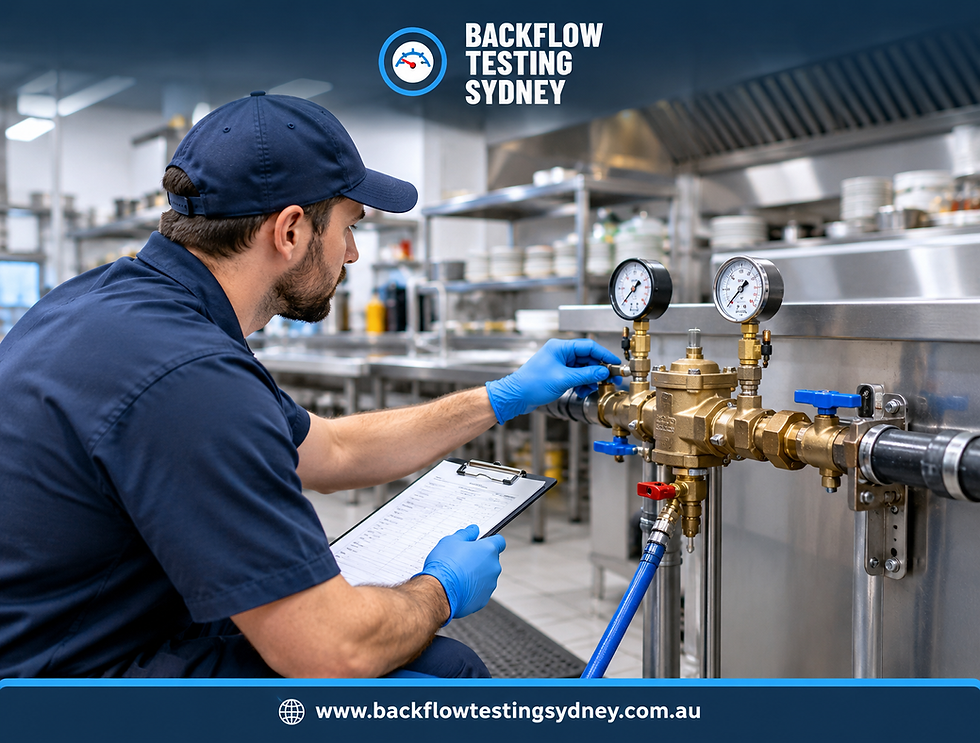
This is the core technical step. The tester connects a calibrated differential pressure test gauge to the device test cocks.
For a DCV, they measure hold pressure across check valve one and check valve two. Each must hold at least 7 kPa or as per the manufacturer's spec.
For an RPZD, they also test the relief valve opening point. It must open at a not less than 14 kPa differential and the upstream check must hold at least 35 kPa. This proves the device will dump water rather than let contamination through.
Step 5: Relief Valve And Air Inlet Performance Check
On RPZ devices, the relief valve is critical. The tester simulates a backpressure event to confirm the relief port opens and continuously discharges.
On pressure vacuum breaker devices, they check the air inlet opens at the correct pressure. If debris, worn seals or weak springs prevent operation, the device fails.
Step 6: Reinstatement, Cleaning And Second Pass
After checking, the plumber will give the line a gentle flush to remove any debris. They will also reseat the valves in the right order so as to avoid water hammering, starting first with the inlet and then the outlet.
They will advise what caused the failure. The common reasons are scale deposits, faulty seals, or worn-out springs. A simple service and retest under AS2845.3 may be possible on the same day.
Step 7: Documentation and Sydney Water Lodgement
A compliant test is not complete until paperwork is lodged. The tester then completes the official backflow prevention device test report.
The tester will document the address, water metre number, device type, manufacturer, model, serial number, size, location, readings, pass/fail indication, tester name, licence number and accreditation.
Results must be reported within Sydney Water Tap In at a time of your choice, usually within 2 business days. You will then receive a certificate of compliance and acknowledgement for your records. This is the process that removes your notice.
Stay Ahead Of Your Annual Test
Annual testing is for one reason. It prevents contaminated water from entering Sydney’s drinking water supply. The seven steps above ensure that your machine is checked over, pressure tested, checked over in faulty conditions, and correctly accredited under NSW law.
For property managers and business owners, booking early is the simplest way to stay compliant. By booking, you get a simple, one-stop service that includes booking, onsite testing and same-day lodgement, with Backflow Testing providing Sydney Water-accredited testing at a flat rate with 24-hour lodgement.
If your notice is due, there is no point waiting for a second reminder. Knowing about the backflow prevention testing Sydney procedure now means no more unexpected charges and complete protection for your site and the network.


Comments